
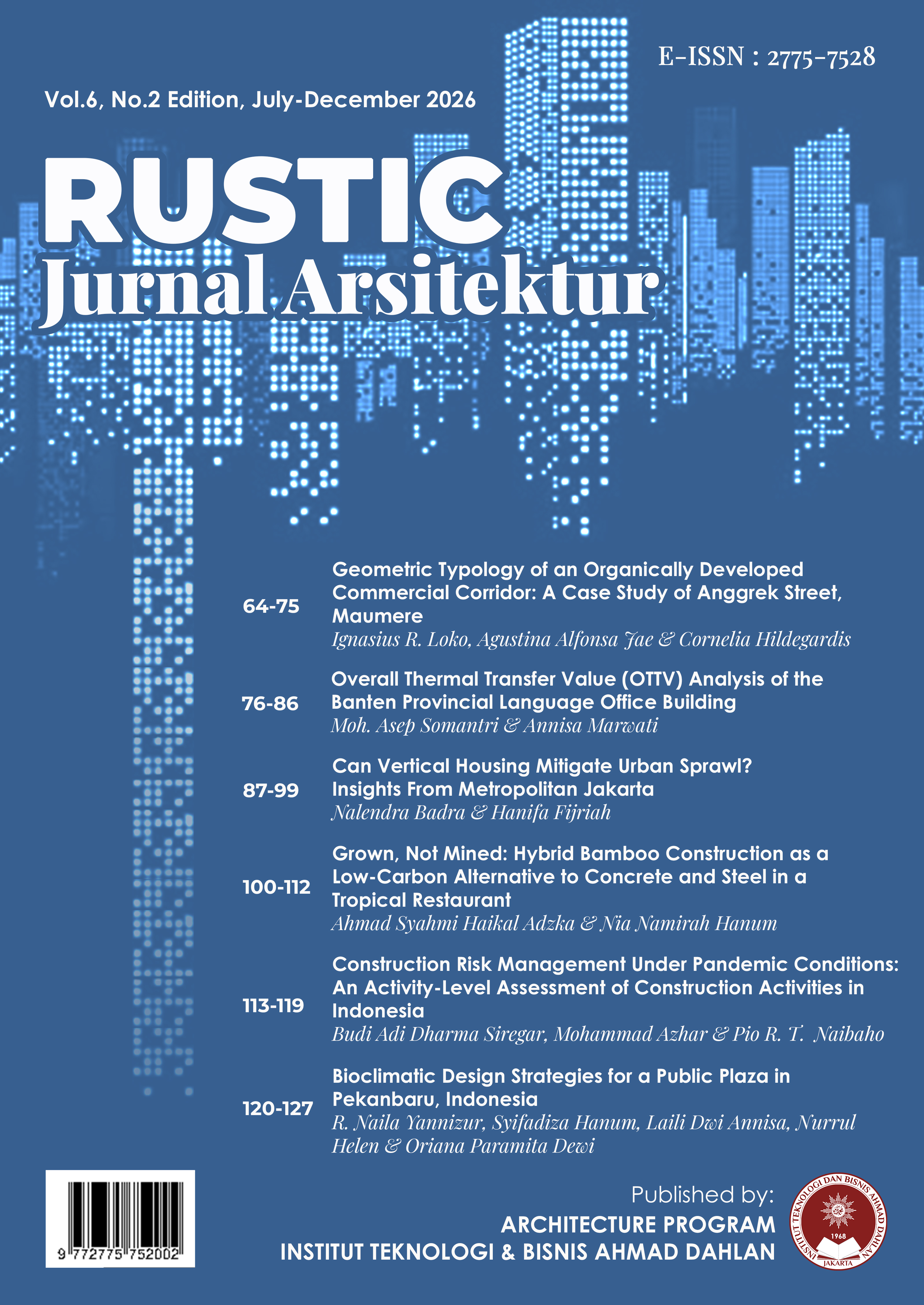
Bioclimatic Design Strategies for a Public Plaza in Pekanbaru, Indonesia
DOI:
https://doi.org/10.32546/rustic.v6i2.3528Keywords:
Bioclimatic, Architecture, Energy efficiency, Commercial plaza, PekanbaruAbstract
The development of commercial areas in major cities such as Pekanbaru continues to grow rapidly in line with increasing economic activity and the rising demand for multifunctional public spaces. However, most commercial buildings in Indonesia remain focused on visual image-making and modern aesthetics, with limited consideration for energy efficiency and thermal comfort. This design study examines the application of bioclimatic architectural principles to a three-story commercial plaza whose primary functions include a culinary center, coworking space, and retail area. The aim of this design is to create a climate-responsive and energy-efficient building that ensures optimal thermal comfort for its users. The design method employs a bioclimatic approach through analysis of building orientation, spatial layout, facade treatment, and the integration of passive elements such as vegetated balconies, secondary skin, and overhangs. The design results indicate that the façade strategy using a secondary skin effectively reduces direct heat exposure from the west, while the addition of vegetation on balconies and the roof provides natural shading and enhances the building’s visual quality. Furthermore, the spatial orientation based on sun path and wind flow improves the efficiency of natural lighting and ventilation. Overall, this design demonstrates that the integration of passive architectural elements can create sustainable commercial buildings that are adaptive to tropical climatic conditions.
References
Muliadi, I. Nugraha, and F. Dalilla, “Analisis Urban Heat Island Menggunakan Citra Landsat Di Kota Pekanbaru,” Journal of Urban Regional Planning and Sustainable Environment, vol. 3, no. 01, Jun. 2024, doi: 10.25299/jurps.2024.17874.
Sandra Loekita, “Analisis Konservasi Energi Melalui Selubung Bangunan,” Civil Engineering Dimension, vol. 8, no. 2, pp. 93–98, 2006, [Online]. Available: http://puslit2.petra.ac.id/ejournal/index.php/civ/article/view/16465
Hermawan, N. Faqih, and A. N. Arrizqi, “Kenyamanan dan Kinerja Termal Rumah Vernakular di Sayung Demak, Indonesia,” Kinerja Termal Rumah Vernakular, vol. 5, no. 1, pp. 82–93, 2022, [Online]. Available: http://ejournal.upi.edu/index.php/jaz-
W. Tang et al., “Prediction and evaluation of air conditioner energy consumption of residential buildings in the Yangtze River Basin,” Journal of Building Engineering, vol. 65, Apr. 2023, doi: 10.1016/j.jobe.2022.105714.
S. Ma and A. Putri, “Perancangan Mall Dan Apartemen Di Medan Tema Arsitektur Bioklimatik,” Jurnal Ruang Luar dan Dalam, vol. 07, no. 01, pp. 261–271, 2024, [Online]. Available: https://ejurnal.istp.ac.id/index.php/jrld
A. Hassina, M. Toufik, and S. Imène, “Bioclimatic design approach in colonial office buildings architecture in Algeria,” South Florida Journal of Development, vol. 5, no. 6, p. e4073, Jul. 2024, doi: 10.46932/sfjdv5n6-015.
M. Rizky Abubakar and P. Fitriaty, “Principles of Bioclimatic Architecture in the Tropics Case Study: Mesiniaga Tower,” International Journal of Research in Engineering and Science (IJRES), vol. 13, no. 1, pp. 105–114, 2025, [Online]. Available: https://www.ijres.org/papers/Volume-13/Issue-1/1301105114.pdf
S. Sujatini, N. F. Qolby, and E. P. Dewi, “Penerapan Arsitektur Bioklimatik Pada Menara Mesiniaga, Rumah Misol, dan Kos Keputih,” IKRAITH-Teknologi, vol. 6, no. 3, pp. 75–85, Nov. 2022, doi: 10.37817/ikraith-teknologi.v6i3.2308.
V. Olgyay, “Design With Climate: Bioclimatic Approach to Architectural Regionalism Princeton University Press,” 1973.
K. Yeang, BIOCLIMATIC SKYSCRAPERS. ellipsis London Ltd, 1994.
K. Taing, S. Reiter, V. Han, and P. Leclercq, “Bioclimatic Design Guidelines for Design Decision Support to Enhance Residential Building Thermal Performance in Tropical Regions,” Sustainability (Switzerland), vol. 17, no. 4, Feb. 2025, doi: 10.3390/su17041591.
P. U. Okoye, O. G. Ogbuagu, C. I. Ohaedeghasi, and C. Ngwu, “Bioclimatic practices in modern residential building design and construction in South-Eastern Nigeria,” Journal of Construction Engineering, Management & Innovation, vol. 3, no. 3, pp. 158–178, Sep. 2020, doi: 10.31462/jcemi.2020.03158178.
M. Maulidina and F. Murti, “Application Of Bioclimatic Architecture According To Ken Yeang In Pucang Anom Market Redesign Surabaya Penerapan Arsitektur Bioklimatik Menurut Ken Yeang Pada Redesain Pasar Pucang Anom Surabaya,” Arsitektur Universitas Pandanaran Jurnal, vol. 3, no. 2, pp. 195–201, Nov. 2023, doi: 10.54325/arsip.v3i2.58.
H. K. Cahyaningrum And H. K. Cahyaningrum, “Implementasi Prinsip Desain Arsitektur Bioklimatik Pada Bangunan Perpustakaan Di Klaten,” Arsitektura, vol. 15, no. 2, p. 434, Nov. 2017, doi: 10.20961/arst.v15i2.12580.
N. Amalia, A. M. Nugroho, and D. Asikin, “Fasad Bioklimatik pada Rancangan Perpustakaan Umum di Kedung Kandang Kota Malang,” Jurnal Mahasiswa Jurusan Arsitektur Universitas Brawijaya, vol. 2, no. 2, 2014, [Online]. Available: http://arsitektur.studentjournal.ub.ac.id/index.php/jma/article/view/58
M. Fikri and A. Abdullah, “Penerapan Konsep Arsitektur Bioklimatik pada Perancangan Pondok Pesantren di Gowa,” Journal of Muhammadiyah’s Application Technology, vol. 4, no. 1, pp. 45–51, 2025.
Santy, H. Matsumoto, K. Tsuzuki, and L. Susanti, “Bioclimatic analysis in pre-design stage of passive house in Indonesia,” Buildings, vol. 7, no. 1, 2017, doi: 10.3390/buildings7010024.
T. Chenvidyakarn, “Passive Design for Thermal Comfort in Hot Humid Climates,” Journal of Architectural/Planning Research and Studies (JARS), vol. 5, no. 1, 2018, doi: 10.56261/jars.v5i1.169198.
A. J. Sitorus, D. A. Sembiring, W. Abdillah, and D. D. Harisdani, “Thermal Comfort in Humid Tropical Climate Areas (Case Study on Open Spaces and Shaded Spaces in Medan City),” International Journal of Architecture and Urbanism, vol. 7, no. 2, 2023, doi: 10.32734/ijau.v7i2.13512.
Downloads
Published
Issue
Section
License
Copyright (c) 2026 RUSTIC

This work is licensed under a Creative Commons Attribution 4.0 International License.
