
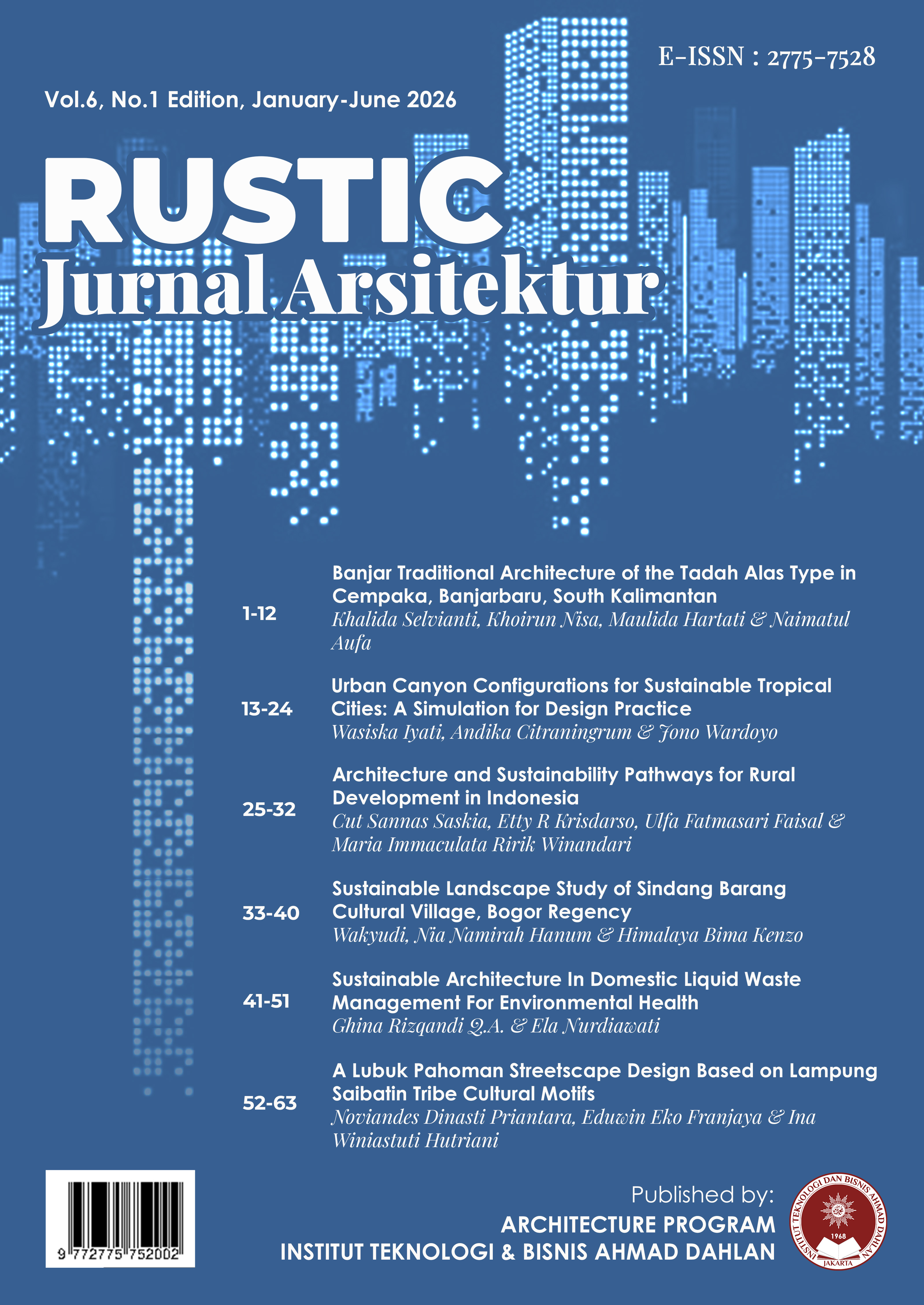
Architecture and Sustainability Pathways for Rural Development in Indonesia
DOI:
https://doi.org/10.32546/rustic.v6i1.3221Keywords:
Architecture, Ecotourism, Productive landscapes, Rural development, SustainabilityAbstract
Rural landscapes in Indonesia reflect the coexistence of strong agrarian traditions and the pressing need for sustainable development, requiring approaches that integrate ecological, spatial, and socio-economic systems. Ciambar District in Sukabumi Regency, West Java, serves as a representative case study, characterized by agricultural activities such as rice, cassava, and durian cultivation, extensive forest areas, and ecotourism potential, including Curug Luhur Waterfall. Despite these assets, the district faces persistent challenges, including inadequate infrastructure, unequal access to clean water, and heavy reliance on small-scale agriculture. From the perspective of architectural sustainability, Ciambar must be re-envisioned as an integrated landscape of productive, ecological, and social spaces. Approaches such as productive landscapes, ecological infrastructure, and low-impact ecotourism demonstrate how spatial and architectural interventions can simultaneously support livelihoods, conserve ecosystems, and enhance local resilience. This study aims to identify, analyze, and map the potentials of Ciambar District based on natural resources, human capital, and local governance capacity. The findings are expected to provide a comprehensive assessment of existing strengths and opportunities, along with strategic recommendations for sustainable environmental development that supports the local economy while aligning with broader sustainability frameworks.
References
S. Banerjee, L. Lucas dos Santos, and L. Hulgård, “Intersectional knowledge as rural social innovation,” J Rural Stud, vol. 99, pp. 252–261, Apr. 2023, doi: 10.1016/J.JRURSTUD.2021.04.007.
Douglas Farr, Sustainable Urbanism: Urban Design With Nature. New Jersey: John Wiley & Sons., 2008.
T. Wijijayanti, Y. Agustina, A. Winarno, L. N. Istanti, and B. A. Dharma, “Rural tourism: A local economic development,” Australasian Accounting, Business and Finance Journal, vol. 14, no. 1 Special Issue, pp. 5–13, 2020, doi: 10.14453/aabfj.v14i1.2.
H. Naomi and F. Murialdo, “From architecture to community: adaptive reuse as social practice,” in Connectivity and creativity in times of conflict, Academia Press, 2023. doi: 10.26530/9789401496476-126.
N. P. Kelkar and G. Spinelli, “Building social capital through creative placemaking,” Strategic Design Research Journal, vol. 9, no. 2, 2016.
A. E. da Silva, K. F. B. Maracajá, A. C. S. Batalhão, V. F. Silva, and I. M. S. Borges, “Ecotourism and Co-Management: Strengthening Socio-Ecological Resilience in Local Food Systems,” Sustainability, vol. 17, no. 6, 2025, doi: 10.3390/su17062443.
United Nations, “Transforming our world: The 2030 agenda for sustainable development.” Accessed: Sep. 12, 2025. [Online]. Available: https://sdgs.un.org/2030agenda
N. Kabisch, S. Qureshi, and D. Haase, “Human–environment interactions in urban green spaces — A systematic review of contemporary issues and prospects for future research,” Environ Impact Assess Rev, vol. 50, pp. 25–34, 2015, doi: https://doi.org/10.1016/j.eiar.2014.08.007.
M. I. Abubakar Abdurrahman, “Peran Arsitektur Berkelanjutan Dalam Perwujudan Kota Sehat,” RUSTIC, vol. 3, no. 2, pp. 98–112, Jun. 2023, doi: 10.32546/rustic.v3i2.1966.
J. Ahern, “From fail-safe to safe-to-fail: Sustainability and resilience in the new urban world,” Landsc Urban Plan, vol. 100, no. 4, pp. 341–343, 2011, doi: https://doi.org/10.1016/j.landurbplan.2011.02.021.
R. Brown and R. Corry, “Evidence-based landscape architecture: The maturing of a profession,” Landscape and Urban Planning - LANDSCAPE URBAN PLAN, vol. 100, pp. 327–329, Apr. 2011, doi: 10.1016/j.landurbplan.2011.01.017.
A. Viljoen and K. Bohn, Second Nature Urban Agriculture. Routledge, 2014. doi: 10.4324/9781315771144.
J. Rigg, M. Phongsiri, B. Promphakping, A. Salamanca, and M. Sripun, “Who will tend the farm? Interrogating the ageing Asian farmer,” J Peasant Stud, vol. 47, no. 2, pp. 306–325, Feb. 2020, doi: 10.1080/03066150.2019.1572605.
I. Irmawati and H. Hasnawati, “Community-based Ecotourism Strategy for Local Economic Empowerment,” Journal of Education, Humaniora and Social Sciences (JEHSS), vol. 7, pp. 395–404, Nov. 2024, doi: 10.34007/jehss.v7i2.2359.
J. Yan, Y. Huang, S. Tan, W. Lang, and T. Chen, “Jointly Creating Sustainable Rural Communities through Participatory Planning: A Case Study of Fengqing County, China,” Land (Basel), vol. 12, no. 1, 2023, doi: 10.3390/land12010187.
S. O. I. Ramirez-Gomez et al., “Analysis of ecosystem services provision in the Colombian Amazon using participatory research and mapping techniques,” Ecosyst Serv, vol. 13, pp. 93–107, Jun. 2015, doi: 10.1016/J.ECOSER.2014.12.009.
F. Rufaidah, T. Karyani, E. Wulandari, and I. Setiawan, “A Review of the Implementation of Financial Technology (Fintech) in the Indonesian Agricultural Sector: Issues, Access, and Challenges,” Sep. 01, 2023, Multidisciplinary Digital Publishing Institute (MDPI). doi: 10.3390/ijfs11030108.
Vikas and R. Ranjan, “Agroecological approaches to sustainable development,” Front Sustain Food Syst, vol. 8, Nov. 2024, doi: 10.3389/fsufs.2024.1405409.
Downloads
Published
Issue
Section
License
Copyright (c) 2026 RUSTIC

This work is licensed under a Creative Commons Attribution 4.0 International License.


